

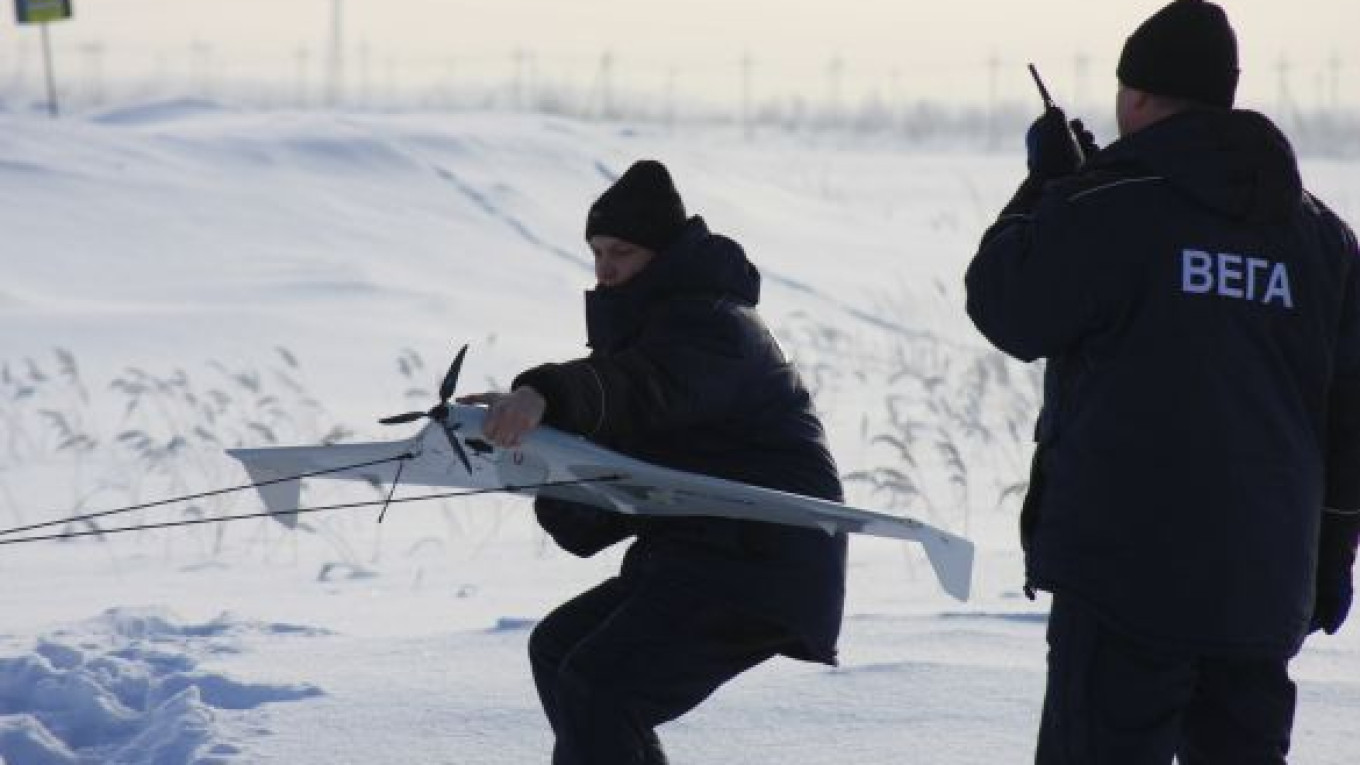
LAKE SAMOTLOR, TYUMEN REGION — The engineer leaned back knee-deep in snow, straining against the taut elastic and released the unmanned drone into the western Siberian sky.
Although more familiar to the inhabitants of Pakistan's tribal belt than Russian oil workers, TNK-BP has introduced military-designed remote sensing equipment as part of a high-technology program to slow the declining output of its aging fields.
Production at Samotlor, Russia's largest oil field for more than 40 years, collapsed following its peak in 1980. But it remains the prime asset of TNK-BP, the country's third-biggest energy company jointly controlled by BP and the oligarch holding Alfa, Access and Renova Group. SamotlorNefteGaz, the main operator of Samotlor and a daughter company of TNK-BP, provides 24 percent of TNK-BP's crude.
Located below a swamp where temperatures range from plus 30 to minus 50 degrees Celsius, the center of the giant field is the shallow Samotlor Lake — Black Lake in the language of the indigenous Khanti people — where the oil wells are drilled from man-made sand deposits, or "pads," linked by artificial roads
TNK-BP's three unmanned drones are part of its push to create "smart fields," where well production is monitored and coordinated from a central control center. The drones' heat sensors detect any abnormal fluctuations in temperature, while video cameras mean they can spot intruders.
But they are just one of the tactics TNK-BP is utilizing to maximize crude output. The company showed some of its recent innovations to journalists during a press tour last week.
Headquartered in nearby Nizhnyvartovsk, SamotlorNefteGaz, or SNG, has more than 6,500 active wells and intends to ship out 17.5 million tons of oil in 2012, a slight decrease on the 17.76 million tons in 2011. TNK-Nizhnyvartovsk, another daughter company of TNK-BP, operates the northern part of the field and is aiming to produce 8 million tons.
TNK-BP's management has a target of reducing production decline — now at 7 percent — to 1 percent by 2016.
Chief engineer Sergei Shevchenko said the company has spent 72 million rubles ($2.4 million) on implementing its "smart fields" project since 2010 and that it will be fully functional by 2013. SNG will also spend 840 million rubles ($30 million) over the next decade on technologies to boost production, he said.
During the next three years this will increase income by 1.5 billion rubles, a figure that rises to 8 billion rubles in the next 10 years, Shevchenko added.
One of the key problems at Samotlor, which was exploited at a break-neck pace by oil men working for a Soviet government in dire need of the hard currency oil exports brought, is the amount of water that is pumped out with the oil — the "watercut." On average, Samotlor's wells yield 94 tons of water for every ton of oil.
By some estimates up to 30 percent of western Siberian oil wells are unprofitable, said Ildar Davletshin, an oil analyst with Renaissance Capital.
TNK-BP quadrupled its budget for new technologies to $320 million in 2011, the company said last year. Research and development was 8 percent of its $4 billion annual capital expenditure.
At Samotlor, SNG has also employed techniques such as hydrofracking — the high pressure injection of fluids to open up oil deposits — and sidetracking — drilling new bore holes from existing wells to access bypassed reserves.
There are up to 280 new sidetracks every year carried out by 16 teams, said SNG's chief geologist Andrei Titov, accounting for two-thirds of incremental production. Hydrofracking has been employed since 2000 and between 200 and 300 such operations are undertaken every year, he added.
The challenges presented by older oil fields — or brownfields — are particularly acute for Russian oil majors. Almost 90 percent of TNK-BP's production comes from brownfield sites. Other companies such as Surgutneftegaz, LUKoil and, to a lesser extent, Rosneft also have significant dependency on aging fields. But analyst Davletshin singled out the efficiency of TNK-BP's approach.
"There is a strong link with economics," he said. "In other companies, most of the upstream is in the hands of old-school people with a Soviet background — and a Soviet background is about volumes and meters [drilled]."
Samotlor is also benefitting from the landmark "60/66" tax changes introduced last year. SNG said the alterations had made 70 wells profitable, producing an additional 200 tons per day.
Although the site is in its "fourth phase" of steady decline — following the traditional span of rapid growth, plateau and rapid decline — deputy director of SNG Mikhail Kholodov said the crude will not run dry for more than 100 years.
TNK-BP estimated that there are 720 million tons of oil remaining in Samotlor. The company intends to seek a renewal of its license for the field when it expires in 2038.
A Message from The Moscow Times:
Dear readers,
We are facing unprecedented challenges. Russia's Prosecutor General's Office has designated The Moscow Times as an "undesirable" organization, criminalizing our work and putting our staff at risk of prosecution. This follows our earlier unjust labeling as a "foreign agent."
These actions are direct attempts to silence independent journalism in Russia. The authorities claim our work "discredits the decisions of the Russian leadership." We see things differently: we strive to provide accurate, unbiased reporting on Russia.
We, the journalists of The Moscow Times, refuse to be silenced. But to continue our work, we need your help.
Your support, no matter how small, makes a world of difference. If you can, please support us monthly starting from just $2. It's quick to set up, and every contribution makes a significant impact.
By supporting The Moscow Times, you're defending open, independent journalism in the face of repression. Thank you for standing with us.

Remind me later.