

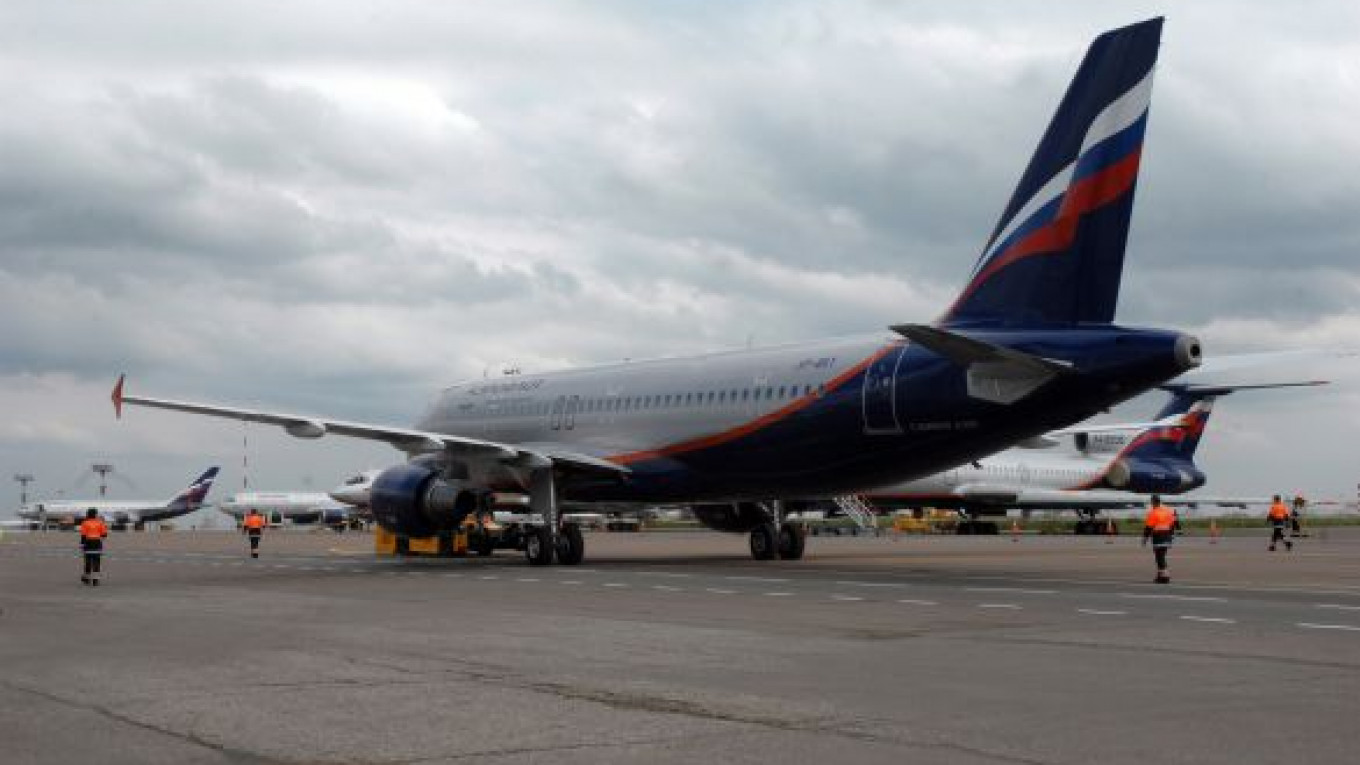
Prime Minister Vladimir Putin reprimanded Aeroflot on Saturday for not purchasing enough Russian-made planes, telling the state-run carrier's CEO that growing profits and dividends were not its only concern.
The airline recently announced plans to purchase a combined 44 planes from Boeing and Airbus, compared with 30 of Sukhoi's regional SuperJet, starting in 2016.
“You want to dominate the domestic market, but you don’t want to buy Russian technology. That won’t do,” Putin told Vitaly Savelyev, according to a transcript of their conversation posted on the government web site.
Savelyev, who took over as chief executive in March 2009, has pushed forward with Aeroflot's campaign to improve its image as an international airline, revamping its fleet and retraining staff. The CEO had been an executive at Vladimir Yevtushenkov's Sistema holding and before that served for three years as a deputy economic development and trade minister.
Earlier this year, Aeroflot was recognized for the first time as best in passenger service on economy-class short- and medium-haul flights, as well as on business-class long-haul flights, among the SkyTeam alliance's seven European airlines.
With airlines across the world taking a major hit during the crisis, Savelyev hurried to show off his company's relatively strong financials, noting that it was one of the few that still turned a profit.
"According to international accounting standards, Aeroflot grew by a factor of 3.5 in terms of profit. We will be paying dividends for 2009 that are twice as high as those for 2008," he said.
Aeroflot's capitalization doubled year on year to reach $2.6 billion, Savelyev said. The company also paid 12 billion rubles (almost $400 million) to the state budget in taxes and customs duties.
The civil aviation market fell by 9.4 percent last year, he said, while Aeroflot managed to "stop at the 5.6 percent mark."
But Putin seemed to think Savelyev still had a few things to learn about running a corporation for the state, noting the "inadequacies" of Aeroflot's fleet modernization plans.
The company's six Ilyushin-96 jets in a fleet of 115 planes is too few, Putin said. He asked why Aeroflot has overlooked Tupolev's jets and Irkut's MS-21 when it announced plans to purchase 22 Boeing 787 Dreamliners and 22 Airbus A350s starting in 2016.
Savelyev hurried to redeem himself, noting that the company's consolidation of some struggling regional airlines would bring more Russian-made planes into its park.
"We have Vladivostok Avia, we have Sakhalin Airlines. We are planning to use all the aircraft in the fleet. Mostly it is domestic technology," he told Putin. "It is cheaper. Domestic technology does not involve customs duties, which is why it is effective from an economic point of view. … We will no doubt be using domestic technology," Savelyev said.
In 2009, the number of imported commercial aircraft reached 390 after Russia bought 100 foreign-built planes, according to the data released at the Aircraft Finance and Lease in Russia and the CIS conference in February.
Currently, Russia imposes a 20 percent duty on certain categories of foreign commercial planes, which it introduced to bolster demand for local airplanes. Nonetheless, some 70 percent to 80 percent of all flights by Russian airlines are carried out by foreign planes, analysts estimate. ?
The state has gradually begun to lift and reduce taxes on certain planes. On June 15, a government subcommittee that deals with protectionist measures approved the cancellation of import duties on aircraft with more than 250 seats.
Analysts say foreign planes remain appealing to Russian carriers because of fuel efficiency and fears that domestic models not yet flying could be late to the market.
The MS-21 — an abbreviation for Long-Haul Carrier of the 21st Century — is tentatively scheduled to fly in 2014, with deliveries two years later. The heavily promoted SuperJet has faced delays, although Sukhoi says the first deliveries will be made this year.
"The risks are too high to order a plane that does not exist yet, or that exists but only as a marketing project," said Andrei Rozhkov, a transportation and infrastructure analyst at Metropol.
"Russian planes are cheaper to maintain, but when fuel prices go up, they become unprofitable compared with their foreign counterparts," he said.
The state owns 51.17 percent of Aeroflot and has every right to dictate how the company should be run, Rozhkov said.
A Message from The Moscow Times:
Dear readers,
We are facing unprecedented challenges. Russia's Prosecutor General's Office has designated The Moscow Times as an "undesirable" organization, criminalizing our work and putting our staff at risk of prosecution. This follows our earlier unjust labeling as a "foreign agent."
These actions are direct attempts to silence independent journalism in Russia. The authorities claim our work "discredits the decisions of the Russian leadership." We see things differently: we strive to provide accurate, unbiased reporting on Russia.
We, the journalists of The Moscow Times, refuse to be silenced. But to continue our work, we need your help.
Your support, no matter how small, makes a world of difference. If you can, please support us monthly starting from just $2. It's quick to set up, and every contribution makes a significant impact.
By supporting The Moscow Times, you're defending open, independent journalism in the face of repression. Thank you for standing with us.

Remind me later.