

ST. PETERSBURG — Trumpeters dressed in white uniforms and long-legged drummer girls in blue jackets and cocked hats were playing marches Tuesday as Hyundai Motor launched its first Russian car assembly plant in St. Petersburg.
The company invested a total of $500 million in the facility, which will work in pilot mode until the end of this year and start commercial production in January.
The plant will manufacture the new C-class Solaris, a subcompact car created specially for the Russian market. Production of the four-door sedan will start in January, while manufacturing of the hatchback is scheduled to begin in May.
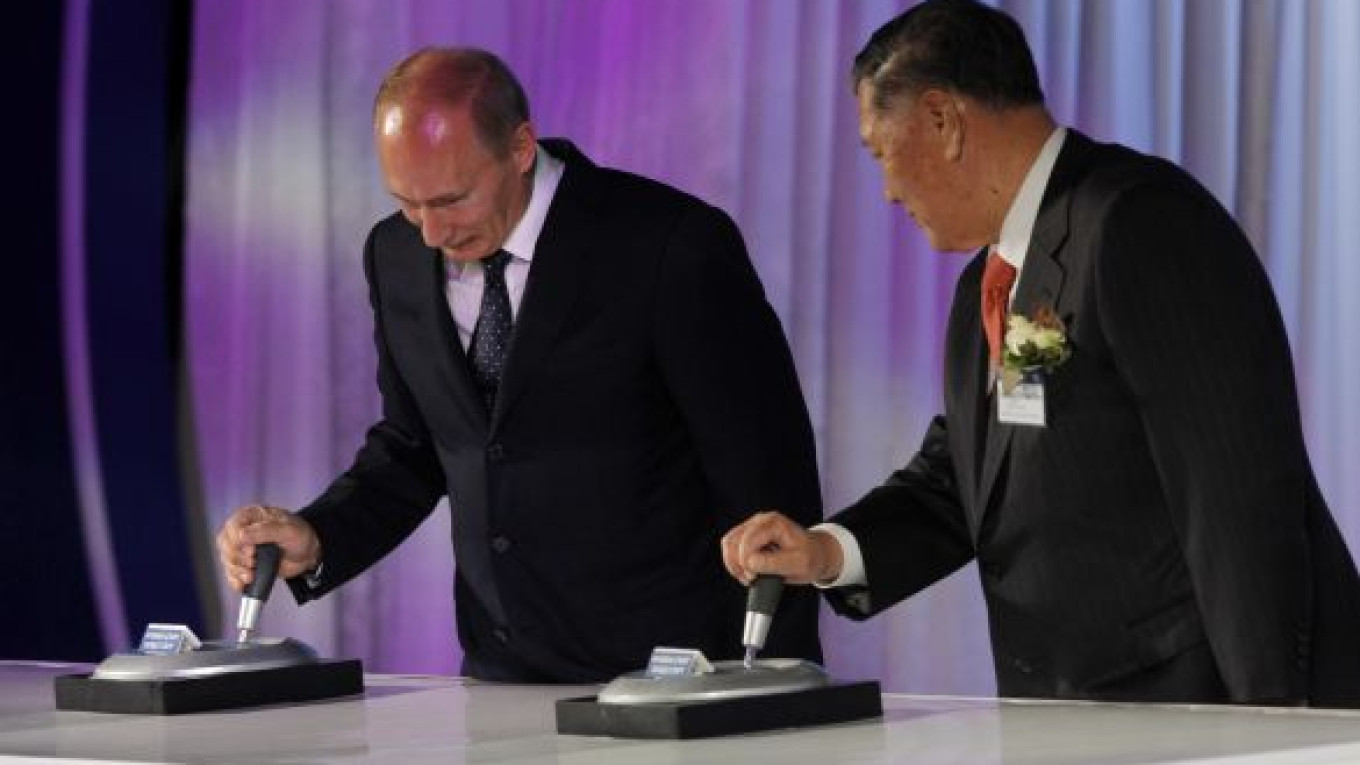
Prime Minister Vladimir Putin, who took part in the opening ceremony, and Hyundai Motor chairman and CEO Chung Mong-koo kicked off production. Putin took Hyundai officials for a short drive across the plant in the first red Solaris, after which he and Chung signed the hood of the car.
Putin said the enterprise would generate more than 30 billion rubles ($965 million) in tax revenue in the coming years, adding that the opening was a heartening event for Russian motorists.
“This is the opening of a high-tech, world-renowned enterprise with the highest quality standards, which will manufacture cars specially designed for Russian conditions,” he said at the ceremony.
Putin thanked Hyundai officials, who started building the plant in June 2008 “in the full swing of the financial crisis.” The prime minister also attended the grand opening of one of three car-part facilities by Canada's Magna International later that day.
The South Korean automaker said it took into account Russia's long, cold winters and the driving habits of the country's motorists when creating the "strategic" Solaris.
The vehicle’s name, chosen in online voting, originates from the Latin word “sol” meaning the sun.
“While launching Solaris, Hyundai plans to become the sun on the Russian market,” said Kim Wong-il, director of the product strategy division at Hyundai Motor Manufacturing Rus, Hyundai Motor’s subsidiary in Russia.
Hyundai expects the plant to reach an annual capacity of at least 105,000 cars by late 2011. It anticipates the figure to increase to 150,000 vehicles in 2012 as the plant will introduce three working shifts.
The company also plans to expand the model range depending on demand and growth of the Russian market, said Kim Syn-thaek, head of the foreign business division at Hyundai Motor Manufacturing Rus.
Hyundai, which was merged with another South Korean carmaker Kia in 1998, may also launch production of Kia vehicles at the plant “in order to use the facility more effectively,” he said at a news conference at the plant.
Kim Syn-thaek said the company was also considering exporting the vehicles it produces in Russia, although sales domestically would remain the priority.
Hyundai plans to nearly double its sales in Russia to 130,000 vehicles next year, said Karry Cho, chief executive of Hyundai Motor in the Commonwealth of Independent States. The company will have to continue importing vehicles to Russia from South Korea to meet that target.
The company expects to sell 75,000 vehicles in Russia this year. It already sold 47,200 cars in the first eight months, up 22 percent from a year ago and outperforming the market’s 14 percent growth.
Hyundai’s plant is the first full-cycle facility by a foreign carmaker in Russia, located on a 200-hectare site. Production at the plant will include stamping, welding, painting and assembling.
The company hopes to produce the vehicles at low cost, largely through its cooperation with 11 South Korean auto-parts suppliers that have built facilities in St. Petersburg and in the Northwest Federal District in the past two years.
The government has stressed that foreign automakers will need to boost the amount of locally made components they use in Russia in coming years. In a government meeting on localizing more auto-parts production in Russia, Putin promised that foreign-branded carmakers working in Russia deserved the same treatment as Russian brands. (Story, Page 5.)
The area around St. Petersburg has already attracted investment from a number of foreign carmakers.
Most recently, Nissan opened a plant producing X-Trail SUVs and the Teana sedan in June 2009. General Motors has made its Opel Astra, Opel Antara, Chevrolet Cruze and Chevrolet Captiva models at a factory that opened in 2008, while Toyota has been manufacturing its Camry in the region since 2007.
Magna's openings Tuesday included two facilities that are part of its joint venture with Shin Young, a Korea-based supplier of major stampings, welded assemblies and tooling. The joint venture, Cosym, will operate one plant in Shushary, outside St. Petersburg, to produce body, chassis and energy-management systems for customers including Hyundai, General Motors, Nissan and Volkswagen, Magna said in a statement.
The other plant, in Kamenka outside St. Petersburg, is a Hyundai-dedicated production site for body sub-assemblies based on parts stamped in Shushary.
Magna said it also opened a plant in Kolpino, also outside St. Petersburg, to produce exterior and interior components for customers including Ford and Nissan. The three plants represented a total investment of 74 million euros ($97 million).
“We expect the Russian automotive market to grow significantly,” Magna chief executive Don Walker said in the statement. “We have expanded our footprint to help our customers grow in this region as well as regions around the world, especially on global platforms.”
Magna operates two other facilities in Nizhny Novgorod and Kaluga.
Putin, who also attended the Magna opening, said he was pleased that the two companies had jointly planned their investment in Russia.
“It's about a rather confident cooperation of our investors on Russian soil, on Russian land,” Putin said.
Staff writer Anatoly Medetsky contributed to this story from Moscow.A Message from The Moscow Times:
Dear readers,
We are facing unprecedented challenges. Russia's Prosecutor General's Office has designated The Moscow Times as an "undesirable" organization, criminalizing our work and putting our staff at risk of prosecution. This follows our earlier unjust labeling as a "foreign agent."
These actions are direct attempts to silence independent journalism in Russia. The authorities claim our work "discredits the decisions of the Russian leadership." We see things differently: we strive to provide accurate, unbiased reporting on Russia.
We, the journalists of The Moscow Times, refuse to be silenced. But to continue our work, we need your help.
Your support, no matter how small, makes a world of difference. If you can, please support us monthly starting from just $2. It's quick to set up, and every contribution makes a significant impact.
By supporting The Moscow Times, you're defending open, independent journalism in the face of repression. Thank you for standing with us.

Remind me later.