

Foreign investors were abuzz Wednesday over a Kremlin-hatched plan to turn the Moscow region town of Skolkovo into a high-tech innovation hub, but kindly advice to the project's backers far outweighed open interest in participation.
President Dmitry Medvedev said Tuesday that he selected billionaire Viktor Vekselberg, a prominent investor both at home and in Europe, to lead the development of Russia's answer to Silicon Valley — particularly by attracting investors and innovators.
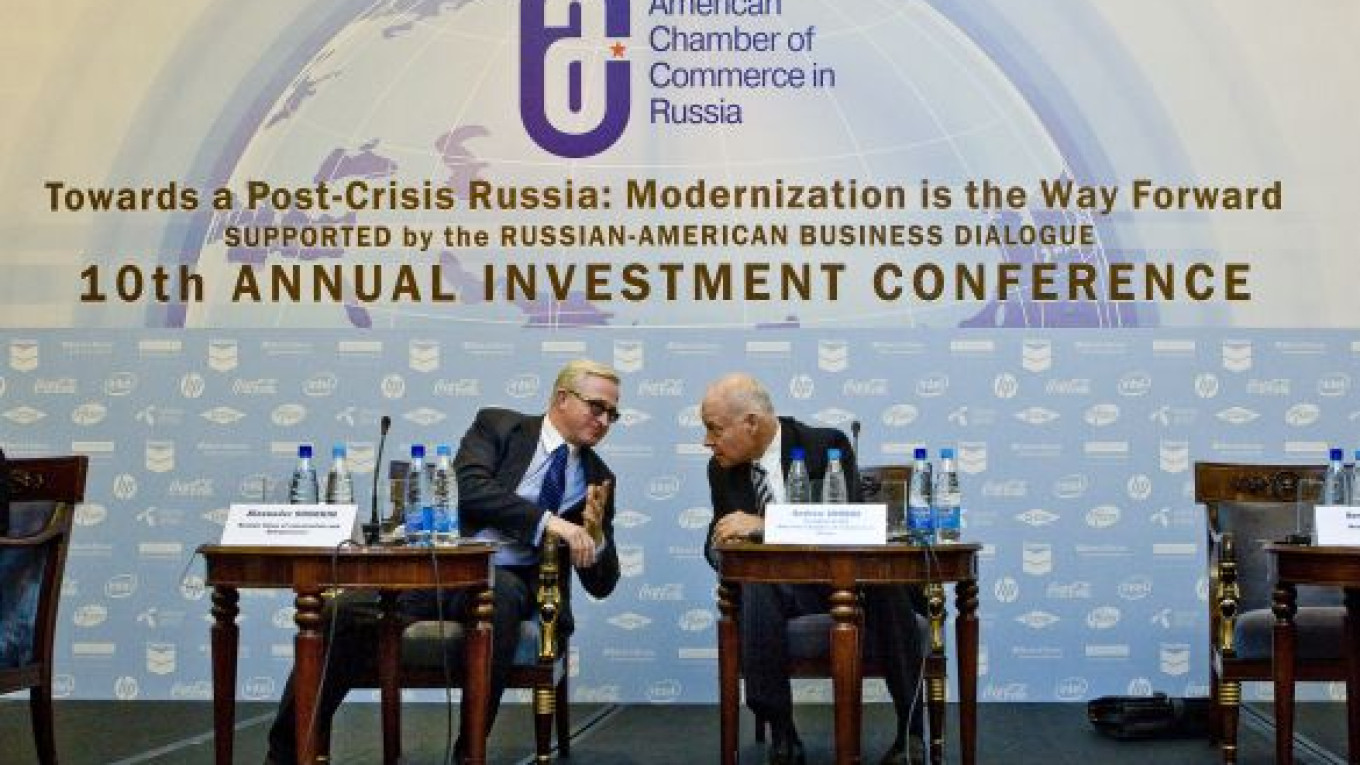
But representatives at the American Chamber of Commerce's 10th annual investment conference said Russia still needed to deal with long-standing issues, such as modernizing what it has and creating a countrywide climate that welcomes business. ?
The recession reminded state officials, after years of confidence from a commodity-driven boom, that foreign investment was important to spurring innovation, said Andrei Goltsblat, managing partner at Goltsblat BLP.
“In 2006 to 2008, the interest in foreign investment was decreasing, as Russian business was strengthening its positions," he said.
The country saw only $44.9 billion in foreign investment last year, compared with $72.9 billion in 2008, according to Central Bank figures.
Despite regular complaints, corruption is not the main obstacle putting off foreign investors, Goltsblat told the conference.
“It is the legal system and transparency of its operation that matters,” he said. “All the investors I meet basically want to know how the legal system works here, how their rights can be guaranteed and why no one in the government addresses these issues.”
Others called the newfound interest in innovation? — and the diversity it is supposed to bring to the economy — a healthy start.
“Russia exports lots of products, primarily oil, gas and metals, which have no added value at all for the foreign consumer,” said Jack Barbanel, senior managing director at Strategic Investment Group. “Russia does not produce anything that consumers on a global level want, and that needs to change.”
But reinventing the wheel is not the right way to modernize and innovate, he said, in an apparent reference to the Silicon Valley comparisons, which have been openly embraced by the Kremlin.
“Sometimes we think we have to create a new iPhone to innovate, but that’s not the case,” Barbanel said.
He said the Skolkovo project had a number of systemic deficiencies that were not taken into account, most notably the decision to build it next to a business school rather than a research institution.
“There should be scientific-specific centers in Russia associated with universities that specialize in sciences — it’s not about MBA or business development, it’s about science,” Barbanel said in a presentation, referring to the Skolkovo business school.
“Skolkovo has no scientific basis, unlike Silicon Valley, [which] has microprocessors, software and Internet,” he said. “The environment should be conducive and supportive, even considering climate,” he said, hinting that the southern resort towns of Sochi or Anapa might be more suitable.
Richard Sobel, CEO of Alfa Capital, cited Smart Village, an Egyptian project launched in 2003 to develop a high-tech cluster in Cairo, as a good example for the Russian development to follow.
“It all started when the government gave them land for free, instead of buying acres from someone who would earn billions on that,” he said. “And companies from the U.S., India and other countries have come to work there.”
Some Russian companies, including state-owned ones, can give the government a good deal of advice on how to modernize the economy, said Jeffrey Costello, CEO of JP Morgan Chase Russia.
“Sberbank in the past had a bad reputation … but over the last three years under the management of German Gref it carried out an enormously ambitious modernization plan, increased efficiency and became more investor friendly,” he said. “Sberbank gained importance globally, and today a lot of foreign investors look at it as a part of their portfolio.”
A Message from The Moscow Times:
Dear readers,
We are facing unprecedented challenges. Russia's Prosecutor General's Office has designated The Moscow Times as an "undesirable" organization, criminalizing our work and putting our staff at risk of prosecution. This follows our earlier unjust labeling as a "foreign agent."
These actions are direct attempts to silence independent journalism in Russia. The authorities claim our work "discredits the decisions of the Russian leadership." We see things differently: we strive to provide accurate, unbiased reporting on Russia.
We, the journalists of The Moscow Times, refuse to be silenced. But to continue our work, we need your help.
Your support, no matter how small, makes a world of difference. If you can, please support us monthly starting from just $2. It's quick to set up, and every contribution makes a significant impact.
By supporting The Moscow Times, you're defending open, independent journalism in the face of repression. Thank you for standing with us.

Remind me later.