

With the presidential election only a few weeks away, a new exhibit of campaign materials at Moscow's State Public Historical Library sheds light on popular tactics used to appeal to voters.
Organized thematically the exhibit — "From the History of Russian Political Technology" — draws from the library's collection of over 10,000 items gathered since 1989.
Especially noteworthy is a display of "black PR," slanderous materials falsely released under a candidate's name.
The exhibit claims to be the first of its kind in Russia and is almost certainly the only place where you can find kefir containers with political slogans on them and a United Russia booklet on wedding anniversary presents.
For the first time in the history of modern Russia, there is sufficient interest in politics to justify such a display, curator Elena Strukova explained.
"People have started to be interested in politics. They're beginning to understand that their vote counts for something," she commented.
A poster of Vladimir Putin circa 2008 welcomes visitors near the entrance.
"We decided this would be the central display of our exhibit," Strukova said, "If you don't look at the date, you could mistake it for a present-day election ad."
In the ad, Putin endorses Dmitry Medvedev with a caption above reading, "Who's next? You Decide."
The exhibit aims to showcase both PR masterpieces and disasters, although the latter are more in evident.
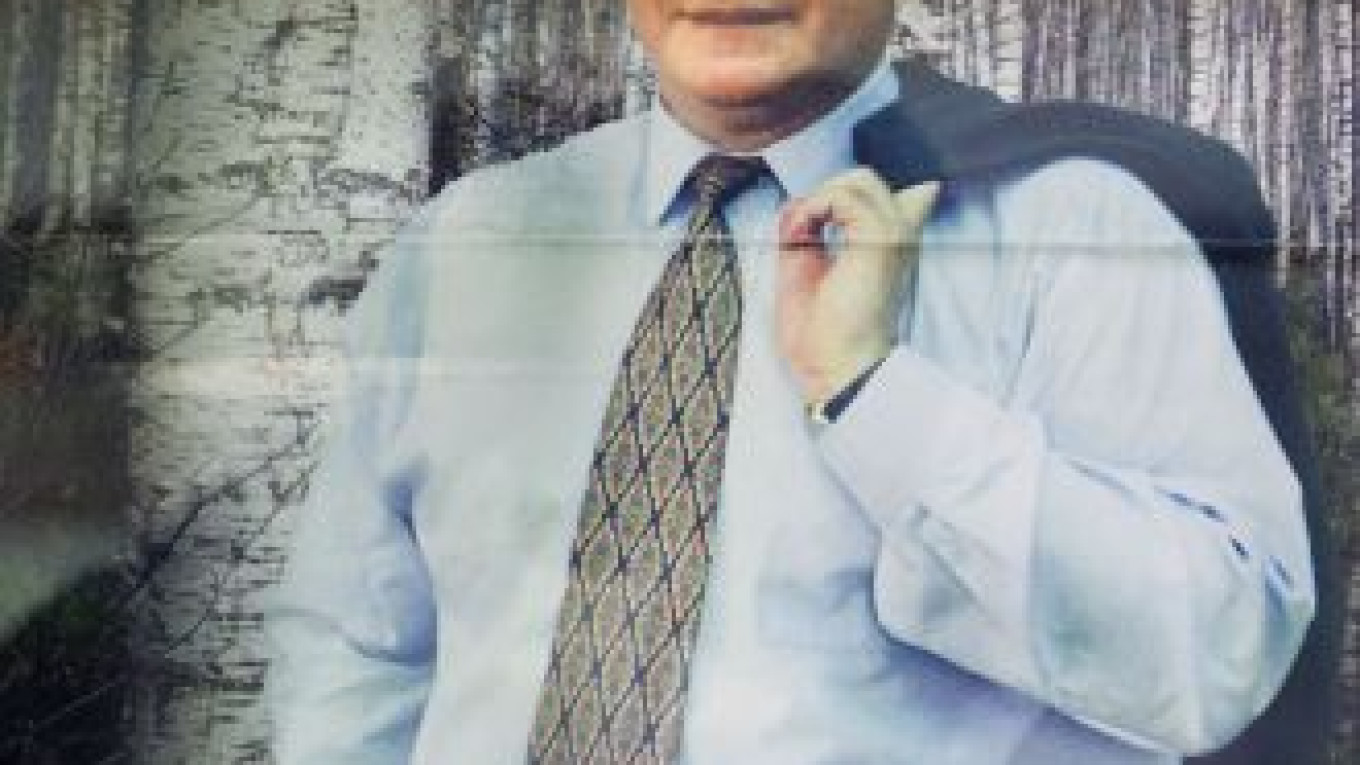
In one poster, Communist Party leader Gennady Zyuganov stands in front of a birch tree looking uncomfortable with the words "flora" and "fauna" inexplicably written below.
Some ads look particularly unwise in retrospect. One poster from the early 1990s shows first Russian President Boris Yeltsin and Yegor Gaidar, the market reformer, in a hot air balloon marked "the Russian economy," casting off ballasts marked "crime" and "corruption" as they float into the sky.
Meanwhile, a Social Democratic Party poster shows a young couple in bed and reads "You never forget your first time," as it urges young, newly eligible voters to go out and vote in the 1995 Duma elections.
The sexually suggestive, youth-oriented ad is a forerunner of the controversial 2011 United Russia "Let's do it together" television commercial that featured two attractive young people getting passionate — and presumably also casting their ballots — in a voting booth.
The most interesting and absurd part of the exhibit is of fake posters aimed against candidates.
One begins with a candidate acknowledging "the difficulty of life for today's pensioners," before advertising a special sale for Siemens cell phones retailing for $159 — hardly a bargain for the elderly in 1990s Russia.
Another example features a joint invitation from the Moscow Choral Synagogue and the Azerbaijani diaspora to a Hanukkah celebration in support of a Moscow City Duma candidate.
Technology is notably absent from the exhibit. All of the materials displayed are in paper format, although the library is trying to update them.
Attempts to modernize the collection are currently underway, and the library has been taking screenshots of relevant online material for the last four years and is taking part in a project to archive specific sites.
"From the History of Russian Political Technology" runs until Feb. 21 at the State Public Historical Library. 9 Starosadsky Pereulok, Bldg. 1, Metro Kitai-Gorod. Mon. through Fri. 625-6514. .
A Message from The Moscow Times:
Dear readers,
We are facing unprecedented challenges. Russia's Prosecutor General's Office has designated The Moscow Times as an "undesirable" organization, criminalizing our work and putting our staff at risk of prosecution. This follows our earlier unjust labeling as a "foreign agent."
These actions are direct attempts to silence independent journalism in Russia. The authorities claim our work "discredits the decisions of the Russian leadership." We see things differently: we strive to provide accurate, unbiased reporting on Russia.
We, the journalists of The Moscow Times, refuse to be silenced. But to continue our work, we need your help.
Your support, no matter how small, makes a world of difference. If you can, please support us monthly starting from just $2. It's quick to set up, and every contribution makes a significant impact.
By supporting The Moscow Times, you're defending open, independent journalism in the face of repression. Thank you for standing with us.

Remind me later.