

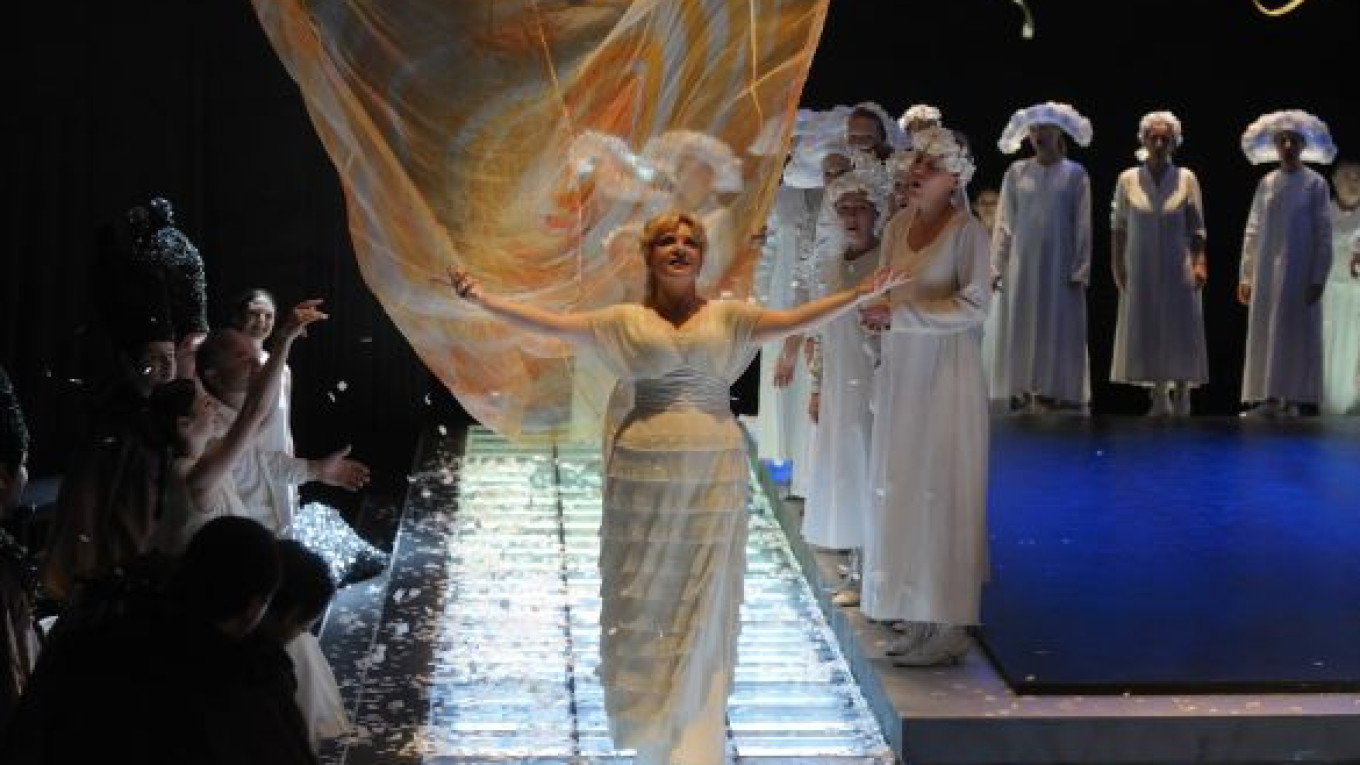
ST. PETERSBURG — A minimalist and deeply philosophical show is perhaps not quite what most people would expect from a production of Verdi’s “Aida” directed by a man who has made an international career producing shows for a circus. Yet this is exactly what Swiss-born director Daniele Finzi Pasca is offering audiences at the Mariinsky Theater Concert Hall.
Most productions of ?€?Aida,?€? regardless of where they are staged, thrive on opulence and ethnic chic. The culmination of these aesthetics is usually reached in the famous march scene in Act II, in which the audience is generally offered a visual feast of a seemingly endless procession of richly dressed Egyptian warriors being greeted by figures in equally ornate dress.
There is none of that in the Mariinsky?€™s new ?€?Aida,?€? however.? As the Mariinsky symphony orchestra indulged in the bravado and pomp of the march, the sole figure moving on stage was an acrobat rolling around inside a large wheel. The opera?€™s characters, the army included, simply stood and watched.
Furthermore, pacifist-minded Finzi Pasca begins his show by casting sublime ridicule on the idea of war itself. At the opening of ?€?Aida,?€? the audience sees a stage densely covered by small, flat wooden soldiers. Amneris easily knocks one of them over, causing the entire army to fall to the ground like dominoes. After all the soldiers have collapsed, the cast mounts the stage to pick them up and take them away, clearing the stage for the opera?€™s action.
The sole acrobat in the march scene can be interpreted as projecting a similar idea to that expressed by Leo Tolstoy in ?€?War and Peace:?€? That of delegating one warrior from both armies to decide the fate of a war, rather than pitting thousands and thousands of soldiers against each other, in order to save lives.
What links ?€?Aida?€? with Finzi Pasca?€™s show ?€?Corteo,?€? with which Cirque du Soleil toured Russia last year, is a sense of surreal fantasy. In ?€?Corteo,?€? the audience watches a clown?€™s dream about his death and funeral that is magically transformed into a carnival. ?€?Aida?€? is designed in the same ethereal aesthetic. Firstly, the director has cleansed the production of any visual element that would link it to a particular era or ethnicity. The costumes of both the Egyptians and the Nubians border in style somewhere between circus grotesque and futuristic minimalism.
The show?€™s costume designer seems to have taken a deliberately light-hearted approach ?€” take, for instance, the foil shields and swords of the guards who escort Radames to prison ?€” that works very much to the production?€™s advantage, serving to contrast with the weight of the philosophical issues explored by the plot.
In terms of spirit, Pasca?€™s ?€?Aida?€? is both humane and intimate. The director seemingly chose to make Amneris a central character. Yekaterina Semenchuk?€™s performance strengthens Pasca?€™s ideas. Head and shoulders above the rest of the cast, Semenchuk dazzled as the pharaoh?€™s daughter, tormented by her jealousy, engrossed by her sorrow, troubled by her tardy remorse and devastated by her sudden loneliness. Her stage partners failed to create as emotionally captivating incarnations of their characters. Yekaterina Shimanovich was technically adroit as Aida, yet she remained unsettlingly estranged from her supposedly beloved Radames (Avgust Amonov). It did not help that Amonov chose to present a somewhat anemic portrayal of his character, as if trying to depict someone who leaves it up to the women around him to decide his fate. Aida?€™s emotional connection to her father (Edem Umerov) was far more compelling. Umerov created a powerful image of Aida?€™s father, Amonasro, the King of Nubia, at once noble and passionate.
Ultimately, the latest show to enter the Mariinsky repertoire could just as well be titled ?€?Amneris?€? as ?€?Aida.?€?
In an interview before the premiere, Finzi Pasca said ?€?Aida?€? was his first melodrama. The result, however, is much closer to a drama, especially the finale, in which the bitterness and self-reproach of Amneris fuse with the tender voices of the two lovers dying in the tomb.
Amneris?€™ last words, ?€?peace, peace, peace, peace?€? are the motto of Finzi Pasca?€™s show, and Semenchuk could not have given them better treatment. The words were brimming with a range of emotions: A desperate plea, a mantra-like attempt at self-consolation and a call for reconciliation that tragically comes far too late.
?€?Aida?€? next plays on July 8, 9 and 29 at the Mariinsky Theater Concert Hall, 37 Ulitsa Dekabristov. St. Petersburg. Tel. +7 (812) 326-4141, .
A Message from The Moscow Times:
Dear readers,
We are facing unprecedented challenges. Russia's Prosecutor General's Office has designated The Moscow Times as an "undesirable" organization, criminalizing our work and putting our staff at risk of prosecution. This follows our earlier unjust labeling as a "foreign agent."
These actions are direct attempts to silence independent journalism in Russia. The authorities claim our work "discredits the decisions of the Russian leadership." We see things differently: we strive to provide accurate, unbiased reporting on Russia.
We, the journalists of The Moscow Times, refuse to be silenced. But to continue our work, we need your help.
Your support, no matter how small, makes a world of difference. If you can, please support us monthly starting from just $2. It's quick to set up, and every contribution makes a significant impact.
By supporting The Moscow Times, you're defending open, independent journalism in the face of repression. Thank you for standing with us.

Remind me later.