

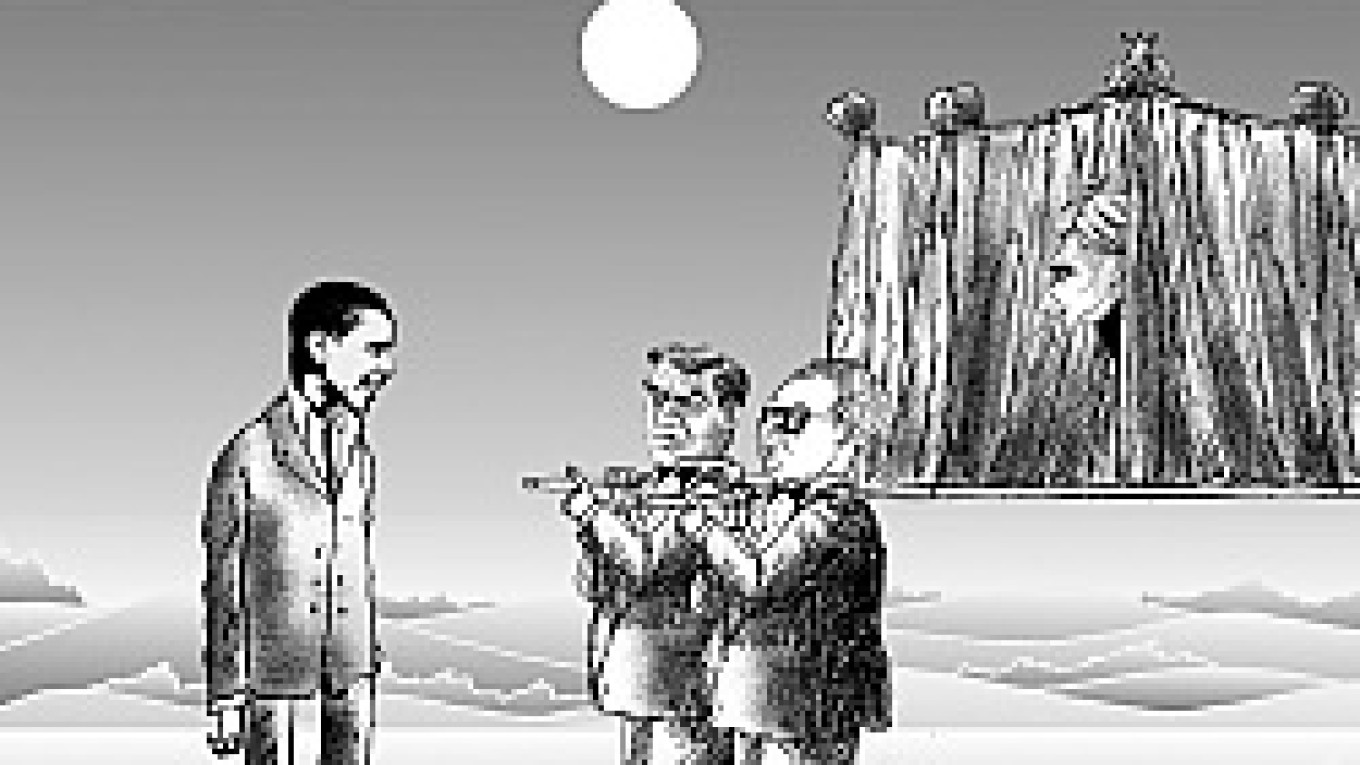
But it is not immediately obvious whether it is Schröder licking Prime Minister Vladimir Putin's boots nowadays or vice versa. The two of them are building -- or trying to build -- the Nord Stream gas pipeline, an exceptionally costly project that satisfies twin strategic objectives. Demonstratively hostile to the interests of both Belarus and Ukraine, the pipeline is intended to ensure that these countries are under Moscow's energy thumb, regardless of who is in power in Minsk and Kiev. As a bonus, the pipeline will also consolidate the Russian economy's status as an appendage of Germany and its chief supplier of natural resources.
The Kremlin's achievements in securing the help of Americans willing to offer their influence are equally impressive. Indeed, U.S. President Barack Obama's policy on Russia is being nurtured with advice from people who have no official position in the administration but have close business ties to Russia and the Kremlin: Former U.S. Secretaries of State Henry Kissinger and James Baker, Kissinger Associates senior director Thomas Graham and Nixon Center president Dimitri Simes. They all write key reports for the administration, shuttling between Moscow and Washington, and coordinate the parameters of the Obama administration's effort to "reset" the bilateral relationship.
Like Schröder, the U.S. advisers are not economically disinterested either. Baker is a consultant for Gazprom and Rosneft, the two energy behemoths at the commanding heights of Russia's economy. The Kissinger Associates lobbying group (whose Russian section is headed by Graham) feeds in to the Kissinger-Primakov working group, a quasi-private-sector effort, blessed by Putin, to deepen ties between Russia and the United States.
It is highly instructive to read the recommendations of these people and groups, as they unobtrusively render the objectives of their Kremlin clients into a language familiar to U.S. leaders.
 | To Our Readers |
|
The Moscow Times welcomes letters to the editor. Letters for publication should be signed and bear the signatory's address and telephone number.
|
"In order to become a genuinely developed and modern country," Graham continues, "in the coming decade, Russia will need to invest at least $1 trillion in modernizing its infrastructure. America and the West in general have a vital interest in seeing the modernization of Russia succeed. The lion's share of the technologies, know-how and a substantial proportion of the investment needs to come from Europe and the U.S.A."
In addition to the technology and investments, Graham quietly slips in a foreign policy suggestion for the Obama administration that is sure to please the Kremlin: "Finlandizing" Ukraine. Unless that sort of appeasement is pursued, he warns, Russia will continue to oppose the United States "wherever and whenever it can." According to Graham, "At the extreme, a weak Russia, with its vast resources and sparse population east of the Urals, could become the object of competition among the great powers, notably China and the United States."
That unspoken "help us develop or we'll let the Chinese do it" threat is a logical development of Putin's homily at this year's World Economic Forum in Davos, where he advocated decisive action to end the world economic crisis. His recipe? Western countries should write off half a trillion dollars' worth of debt owed to them by Russian state corporations run by Putin's pals from the Dresden KGB and the Ozero dacha cooperative from his St. Petersburg days.
But no amount of money will succeed in modernizing Putin's kleptocratic regime, which has already squandered trillions in oil wealth. Simply put, the Putin system is politically, institutionally and intellectually antithetical to the task of modernization.
Graham's only error in his presentation is his attempt to frighten the administration with a hypothetical confrontation between the United States and China over Russian resources. This is not his area of specialization. Kissinger works personally with the Chinese account, jointly propounding with his longtime rival Zbigniew Brzezinski the notion, so seductive for a United States growing weary of its imperial burden, of a global Big Two.
Here is a recent sample of Kissinger's geopolitical arts: "The role of China in a new world order is crucial. A relationship that started on both sides as essentially a strategic design to constrain a common adversary has evolved over the decades into a pillar of the international system. … The Sino-American relationship needs to be taken to a new level. This generation of leaders has the opportunity to shape relations into a design for a common destiny, much as was done with trans-Atlantic relations in the post-war period."
No doubt Kissinger believes every word he wrote, but his ideas also honestly articulate the aspirations of his customers. It's just that not all customers have the same motives. One wants to get his hooks into a further trillion dollars that it can pick away at, while the other wants to become "a central construct of the system of international relations." But in both cases, the customers are getting the influence for which they are paying.
Andrei Piontkovsky is a political scientist and a visiting fellow at the Hudson Institute in Washington. © Project Syndicate
A Message from The Moscow Times:
Dear readers,
We are facing unprecedented challenges. Russia's Prosecutor General's Office has designated The Moscow Times as an "undesirable" organization, criminalizing our work and putting our staff at risk of prosecution. This follows our earlier unjust labeling as a "foreign agent."
These actions are direct attempts to silence independent journalism in Russia. The authorities claim our work "discredits the decisions of the Russian leadership." We see things differently: we strive to provide accurate, unbiased reporting on Russia.
We, the journalists of The Moscow Times, refuse to be silenced. But to continue our work, we need your help.
Your support, no matter how small, makes a world of difference. If you can, please support us monthly starting from just $2. It's quick to set up, and every contribution makes a significant impact.
By supporting The Moscow Times, you're defending open, independent journalism in the face of repression. Thank you for standing with us.

Remind me later.