

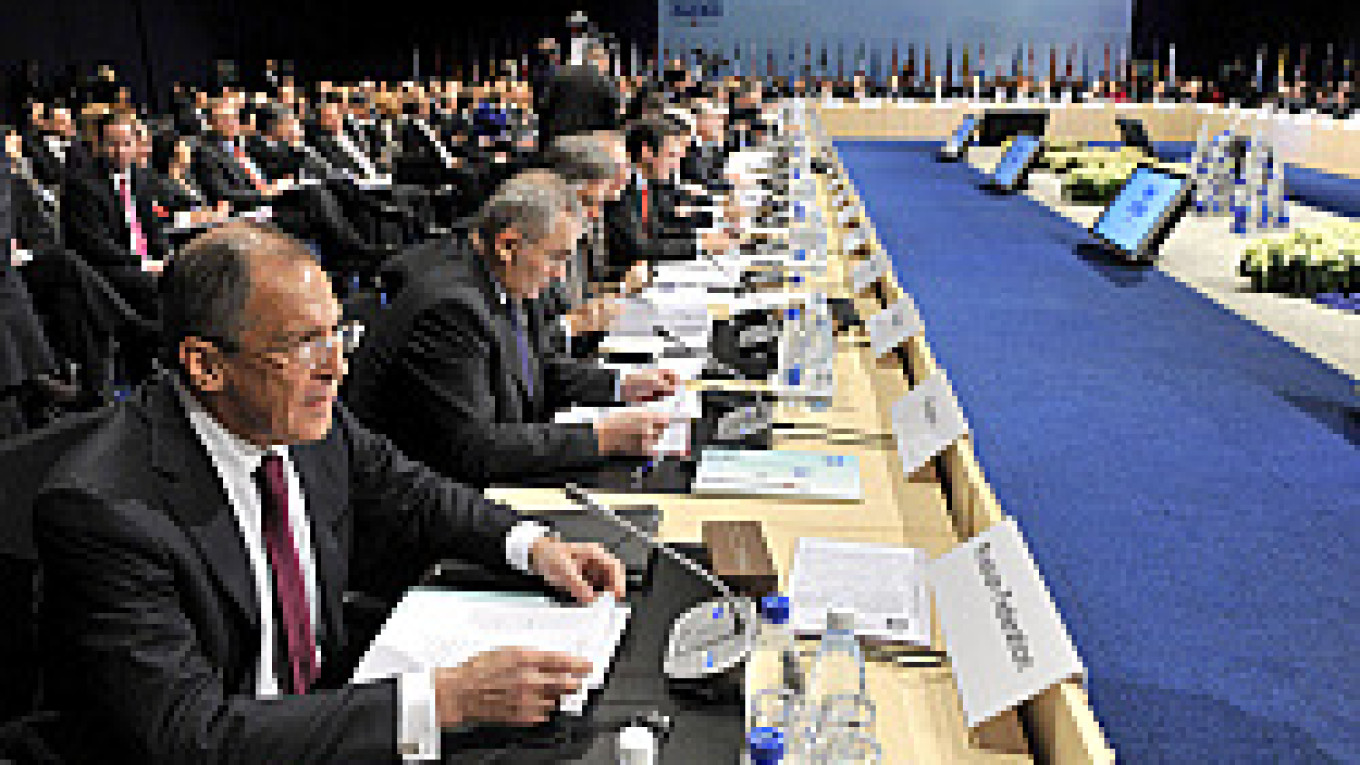
President Dmitry Medvedev says NATO is a Cold War relic, and Foreign Minister Sergei Lavrov used a meeting of the Organization for Security and Cooperation in Europe on Thursday to outline Moscow's ideas for an alternative.
The fallout from Russia's war with Georgia in August also caused friction at the two-day meeting in Helsinki.
U.S. Deputy Assistant Secretary of State Matthew Bryza said in an interview that Russia's proposal for a new collective security pact was directed at NATO.
"There is no need for some new architecture and it is pretty transparent, I think, what that's all about," Bryza said on the sidelines of the OSCE summit. "I think it's about looking for an alternative to NATO, which has worked so well. NATO makes Russia uncomfortable."
France, the current holder of the rotating European Union presidency, has said it was willing to discuss the Russian proposal. But most states in Europe, while saying they would listen to Russia's ideas, have shown little enthusiasm.
"We don't need new international institutions to get things done," Dutch Foreign Minister Maxime Verhagen said. "We only need the common political will to make present institutions work as they were intended to do."
Finnish Foreign Minister Alexander Stubb, whose country holds the rotating OSCE chairmanship, said no firm decision had been made on how to proceed with the Russian proposal.
"This is in the very early stages. We don't have anything concrete, as such, on the table as a proposal," Stubb told a news conference after a private lunch where Lavrov took part in discussions on the plan.
Some Western diplomats have said their governments want Russia to pledge its commitment to the Treaty on Conventional Armed Forces in Europe before they will consider its new security proposals.
German Foreign Minister Frank-Walter Steinmeier offered to host talks on revamping the treaty. "We cannot allow the crisis in the CFE regime to lead to the loss of this pillar of European security," he said.
A Message from The Moscow Times:
Dear readers,
We are facing unprecedented challenges. Russia's Prosecutor General's Office has designated The Moscow Times as an "undesirable" organization, criminalizing our work and putting our staff at risk of prosecution. This follows our earlier unjust labeling as a "foreign agent."
These actions are direct attempts to silence independent journalism in Russia. The authorities claim our work "discredits the decisions of the Russian leadership." We see things differently: we strive to provide accurate, unbiased reporting on Russia.
We, the journalists of The Moscow Times, refuse to be silenced. But to continue our work, we need your help.
Your support, no matter how small, makes a world of difference. If you can, please support us monthly starting from just $2. It's quick to set up, and every contribution makes a significant impact.
By supporting The Moscow Times, you're defending open, independent journalism in the face of repression. Thank you for standing with us.

Remind me later.