

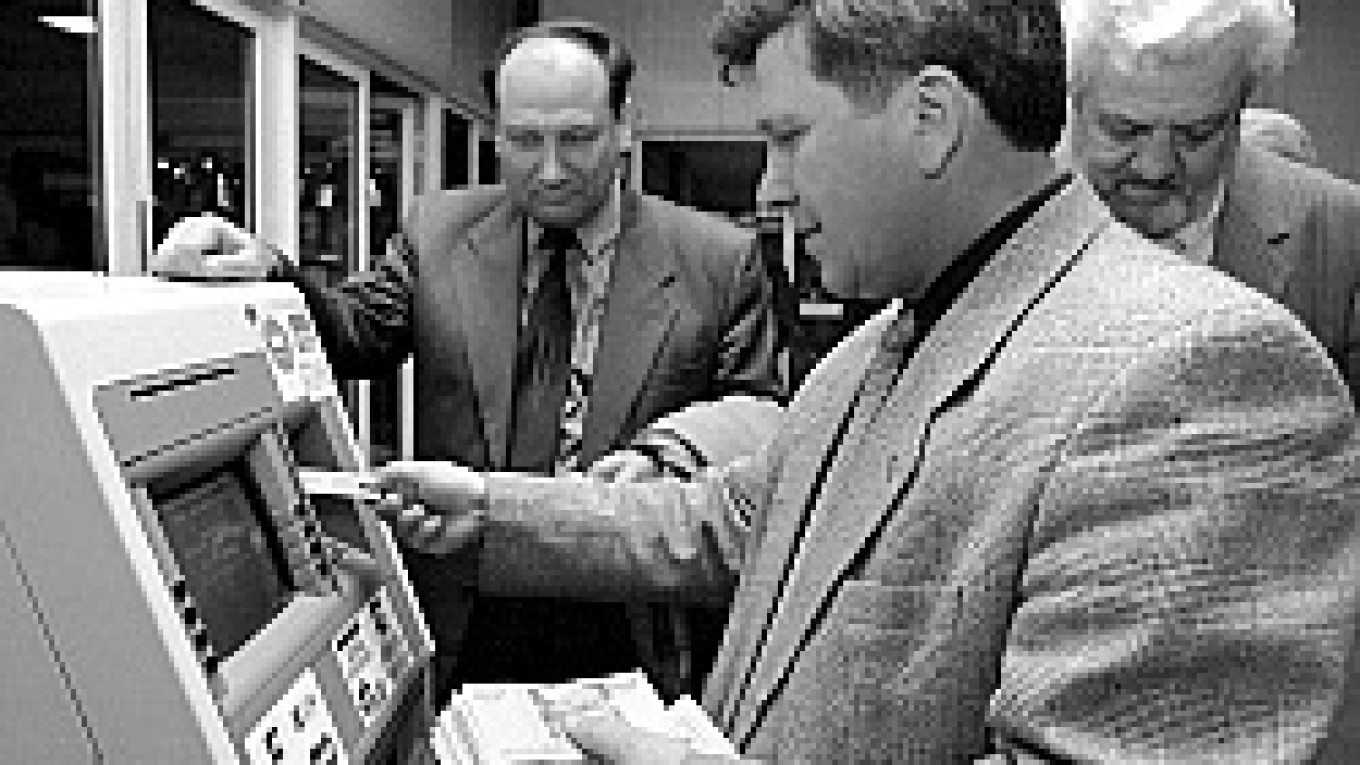
In mid-August 1998, Julia Levit was taking time off her job to bask in the Crimean sun in Feodossia. What saved her from making that vacation an extended one was a television set in her hotel room.
As soon as she heard about the government debt default on Aug. 17, she raced to the closest currency exchange booth and managed to get there to change all of her rubles into dollars before the news hit.
The ruble dropped in value from 6 rubles to the U.S. dollar to more than 20 rubles to the dollar by year's end. People flocked to currency exchanges and banks, as well as stores, where they hurried to dispose of the cash that was devaluing before their eyes. Lines formed at employment agencies starting at 5 a.m. as people were laid off by bankrupted companies.
While the crisis changed the landscape of the economy 10 years ago this Sunday, it also was a personal story for many people, who learned hard lessons, started new careers or left Russia altogether. Interestingly, the crisis is a dim memory for many, blended together with the multiple, post-Soviet crises of Boris Yeltsin's presidency.
Upon returning to Moscow, Levit quickly lost her job in a company that made laser shows for the Moscow government and the city's elite with their newfound wealth. Entertainment companies took a blow right away as thinning wallets forced people to readjust their spending priorities.
"I freaked out and found four different jobs, in addition to college studies," she recalled.
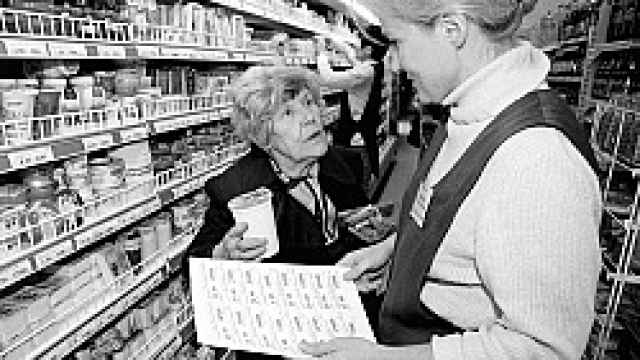 Reuters A customer asks for help from a store clerk changing food prices in a shop, a nearly daily task after the crisis hit. |  |
| |
As the ruble devalued, the quality of life in Russia fell drastically.
Consumer prices increased by an average of 84 percent by the end of 1998, and adjusted salaries in December 1998 were about 60 percent of what they were a year earlier. Even in disproportionately wealthy Moscow, 20 percent of the population dipped below the poverty line, according to the State Statistics Service. In poorer republics like Ingushetia and Kalmykia, this figure reached 90 percent.
As imported foreign goods skyrocketed in price, fortunes were made selling domestic agricultural goods from rural areas in large cities at a substantial markup. The price increase was felt the most in Moscow and other regions with a high share of imports.
Alexander Tkach was making a comfortable salary of $2,000 per month before the crash and hoped to eventually buy an apartment in Moscow. He wanted to move his family from the town of Dzerzhinsk, in the Moscow region, to end the daily commute to his programming job at the Russian Trading System stock exchange.
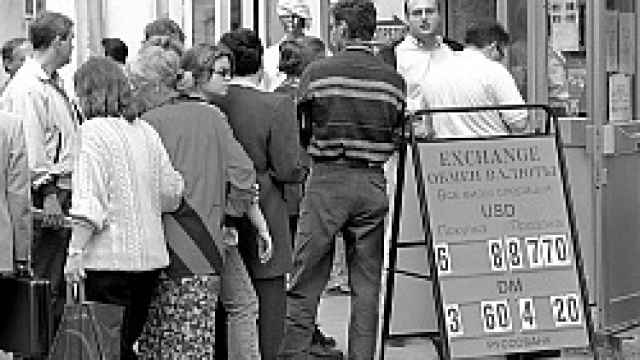 AP People waiting to exchange money in central Moscow on Aug. 19, 1998. | |
| |
Tkach decided to apply for a job with Microsoft in Redmond, Washington. He was interviewed in November, and left Russia in February 1999. In contrast to Russia's plight, the United States was going into the dot-com boom, and computer programmers were sought after.
"I was never one of those people who dreamed of going abroad. Things just coincided," Tkach said by telephone from Sammamish, Washington. Ten years later, he is still working for Microsoft.
Immigration from Russia, which had been sliding since 1995, spiked again to 108,263 people in 1999 compared with 83,674 the year before, according to data from the Interior Ministry. The "brain drain" out of Russia during the 1990s is part of the reason why there is a shortage of qualified professionals in the country today.
Only a small percentage of Russians choose to come back from their established lives in other countries.
When Tkach was offered to head a team of programmers in Novosibirsk in an outsourcing startup, he declined, although the salary was twice what he was earning.
"Financially, the situation is preferable in Russia right now, but we feel more secure in the States, especially with a child," he said.
Increasing incomes and standards of living is a visible trend in Russia over the past eight years. In a 2001 poll by Levada Center, 23 percent said they did not have enough money to eat, and 42 percent spent all of their earnings on food. A similar poll this year indicated that only 12 percent could not afford food, while 60 percent considered themselves sufficiently fed and clothed.
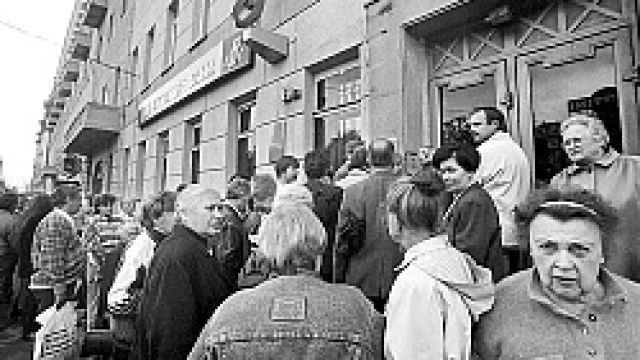 Igor Tabakov / MT Anxious depositors lining up to withdraw savings at an SBS-Agro branch near Pushkin Square. The bank collapsed. | |
| |
"Since 2001, when we first asked this question, the average time people plan ahead is only two years," Bondarenko said. "This is how far ahead Russians think in terms of their careers, family planning, education and investment."
Since most people did not have very much money to lose, the 1998 crash ended up blending in with the other financial hurdles of the 1990s, like the collapses of the ruble in September 1992 and October 1994 and the redenomination of the currency in early 1998.
Only 36 percent of respondents to a Public Opinion Foundation poll this month remembered what happened in Russia in August 1998. But of those who said they were hurt by the crash, 16 percent said their quality of life is still lower than it was in early 1998.
Despite the odds, some successful companies were propelled to success by the 1998 crash. The ability to make lemonade with the lemons of Russia's unstable economic environment has helped lucky risk-takers thrive 10 years later.
Vladimir Vinogradov left his position at a large public relations agency in July 1998 and invested all of his personal savings to start his own firm with a partner. When the default hit a month later, he had nothing to lose because the infant PR firm Pro-Vision Communications consisted of four employees huddled in a small room near the Mayakovskaya metro. "Other firms were laying people off and moving house, and we didn't have a large infrastructure, so we offered lower prices at the time when most companies cut their PR and marketing budgets," he said.
"The default was a good school for us," he added. "It formed our working style and taught us to count our money."
His agency now has 70 employees and more than 30 clients.
"Memories of the crash keep us on our toes," Vinogradov said. "I'm always ready for it to happen again, and I think I know what to do when it does."
A Message from The Moscow Times:
Dear readers,
We are facing unprecedented challenges. Russia's Prosecutor General's Office has designated The Moscow Times as an "undesirable" organization, criminalizing our work and putting our staff at risk of prosecution. This follows our earlier unjust labeling as a "foreign agent."
These actions are direct attempts to silence independent journalism in Russia. The authorities claim our work "discredits the decisions of the Russian leadership." We see things differently: we strive to provide accurate, unbiased reporting on Russia.
We, the journalists of The Moscow Times, refuse to be silenced. But to continue our work, we need your help.
Your support, no matter how small, makes a world of difference. If you can, please support us monthly starting from just $2. It's quick to set up, and every contribution makes a significant impact.
By supporting The Moscow Times, you're defending open, independent journalism in the face of repression. Thank you for standing with us.

Remind me later.