

William Dunbar, a correspondent in Georgia for English-language state channel Russia Today, mentioned the bombing in a report Saturday, and he has not gone on air for the station since.
"I had a series of live, video satellite links scheduled for later that day, and they were canceled by Russia Today," he said by telephone from Tbilisi on Sunday. "The real news, the real facts of the matter, didn't conform to what they were trying to report, and therefore, they wouldn't let me report it.
"I felt that I had no choice but to resign," he added.
A Russia Today spokeswoman said Dunbar resigned when a producer called to arrange a broadcast. She provided a copy of a Georgian media report saying Dunbar protested Russia's "aggression" against Georgia and said the channel assumed that was why he quit.
In an online story dated Saturday, the channel mentions Georgian statements about the Russian bombing raids but says its correspondents in Tbilisi "could not substantiate the reports."
In a further twist of the information flow, Georgia on Saturday terminated broadcasts of Russian news channels Channel One, Rossia and NTV and blocked web sites in the .ru domain.
Meanwhile, Georgian President Mikheil Saakashvili said hackers had crashed many web sites, including those of state agencies. His own site was not loading Sunday, with an Internet browser saying the server stopped responding. Before it went offline, the site was tampered with to show Saakashvili with the kind of mustache sported by Hitler, Interfax reported Saturday.
Russian officials and state media, meanwhile, criticized Western media, saying they had taken Georgia's side and were misinforming their audiences.
Deputy Foreign Minister Grigory Karasin said Sunday that Western media had failed to show the plight of Ossetians and what was left of their capital after it was almost razed by Georgian troops.
Rossia's news program, "Vesti," complained about coverage in U.S. and British media, pointing to an editorial in The Washington Post. The editorial said Russia's military campaign could hamper former Soviet republics and Warsaw Pact countries from pursuing independent policies and that the United States and its NATO allies should "impose a price on Russia if it does not promptly change course."
"Vesti" said such attitudes were misleading. "Not many viewers and readers suspect that their minds are being bombed out the same way as the Ossetian villages, but with words and sentences instead of shells," it said.
It said continental Europe's news organizations had been more objective.
At least nine reporters have been reported injured in the hostilities. An NTV producer was shot and wounded Sunday, Interfax reported. The others include members of a "Vesti" crew, a Komsomolskaya Pravda reporter, an editor and reporter of a Georgian English-language newspaper, and two Turkish reporters for Kanalturk television.
Two other reporters may have been killed, Zaza Gachechiladze, editor-in-chief of Georgian newspaper Messenger, said by phone Sunday.
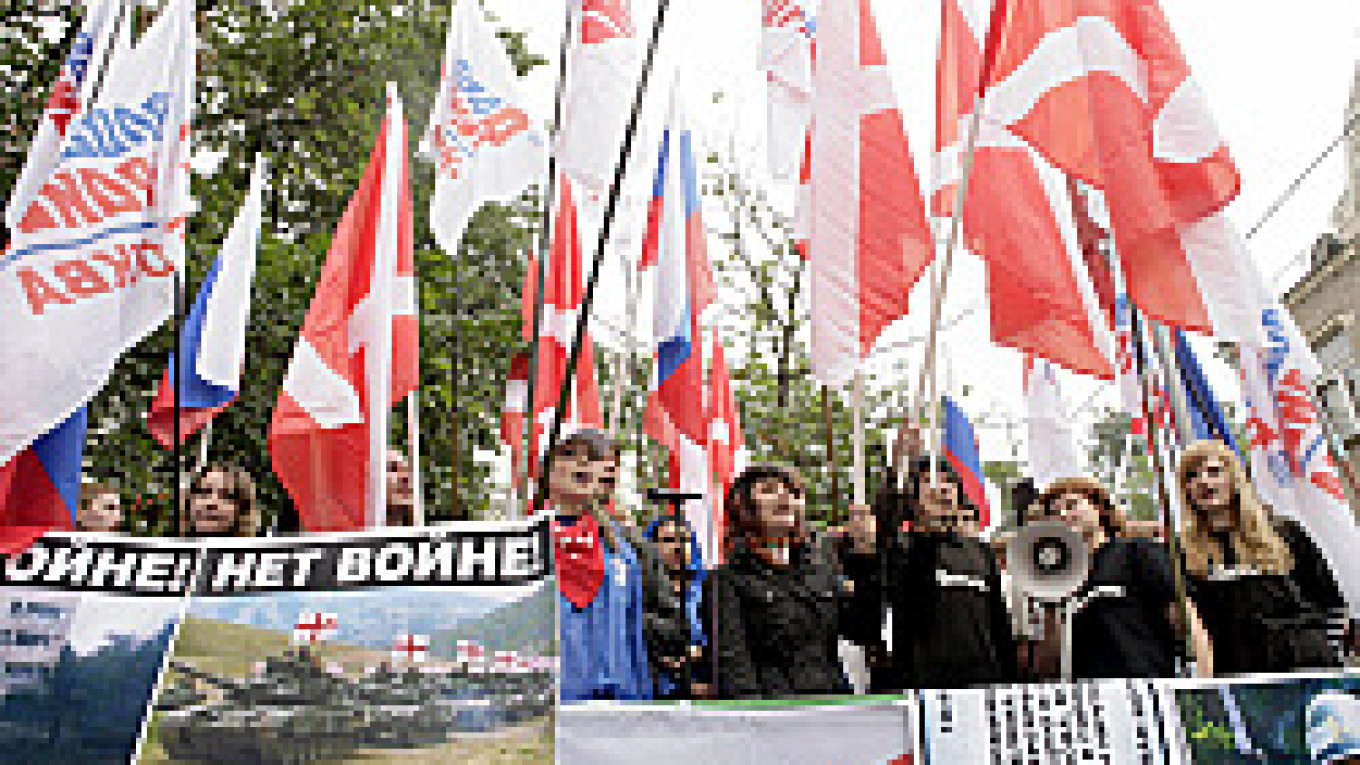
In Moscow, pro-Kremlin youth rallied Sunday at the Georgian Embassy to protest Georgia's "military operation," receiving wide coverage on state TV.
A Message from The Moscow Times:
Dear readers,
We are facing unprecedented challenges. Russia's Prosecutor General's Office has designated The Moscow Times as an "undesirable" organization, criminalizing our work and putting our staff at risk of prosecution. This follows our earlier unjust labeling as a "foreign agent."
These actions are direct attempts to silence independent journalism in Russia. The authorities claim our work "discredits the decisions of the Russian leadership." We see things differently: we strive to provide accurate, unbiased reporting on Russia.
We, the journalists of The Moscow Times, refuse to be silenced. But to continue our work, we need your help.
Your support, no matter how small, makes a world of difference. If you can, please support us monthly starting from just $2. It's quick to set up, and every contribution makes a significant impact.
By supporting The Moscow Times, you're defending open, independent journalism in the face of repression. Thank you for standing with us.

Remind me later.