

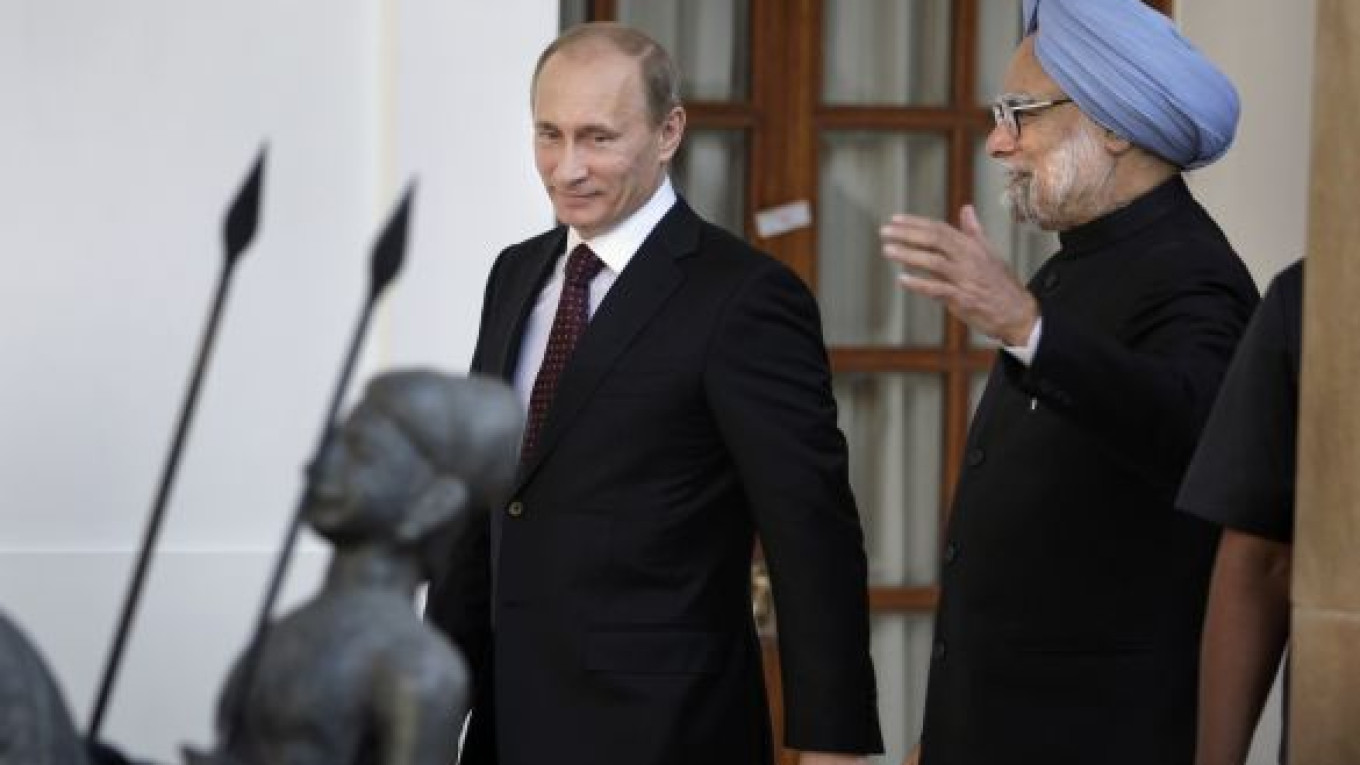
NEW DELHI — Indian Prime Minister Manmohan Singh said Friday that Moscow and New Delhi had completed several important and long-pending defense cooperation projects, emphasizing that ties between the Cold War allies remained close.
India is one of the world's biggest arms importers and Russia's top arms client, with Moscow supplying nearly 70 percent of New Delhi's military hardware.
"We regard Russia as a trusted and reliable strategic partner," Singh told reporters after the talks with Prime Minister Vladimir Putin.
"Russia, unlike other countries, doesn't have any military cooperation with Pakistan out of concern for our Indian friends," Putin said in remarks directed at the United States and China.
The two sides signed a $1.5 billion deal to sell MiG-29K aircraft carrier-based fighter jets to India, with the first deliveries to begin in 2012.
The deal complements a series of agreements marking the end of a protracted dispute over the cost of refurbishing a Soviet-built aircraft carrier, the Admiral Gorshkov, for the Indian navy.
The overhaul, beset by delays and cost overruns, has been the biggest thorn in ties between Russia and India. An additional agreement has been signed to deliver the Soviet-made vessel by the end of 2012, Deputy Prime Minister Sergei Ivanov, a former defense minister, told reporters. He declined to name the price.
Putin said Russia was pursuing technical military cooperation with India that included joint work on a next-generation fighter jet. Sukhoi chief Mikhail Pogosyan told reporters that the company would build more than 1,000 stealth fighter jets within four decades, including at least 200 for India.
Sukhoi test-flew its long-delayed fifth-generation fighter at the end of January, and Moscow said it would be able to compete with its U.S. F-22 Raptor rival built more than a decade ago.
Sukhoi said last week that it hoped the fighter, codenamed the T-50 PAK FA, would be ready for use in 2015.
"If you talk about warplanes of this type, there is definitely a market for it if we produce more than 1,000 jets," Pogosyan said.
"We have all grounds to believe that there will not be tough competition on the world market," he said, adding that Russia would produce more than 1,000 of the planes within 35 to 40 years.
After the test flight, Putin said the country had plenty of work to do on the plane.
Analysts said Russia's plans for a joint venture with India to produce the stealth fighters would likely be watched with unease by Pakistan and regional rival China.
Pogosyan said an agreement on joint output of the jet with India was still in the works and did not say when a deal might be signed.
"I believe that more than 200 planes will be delivered [to India]," Pogosyan said.
"I think [Russia's] Defense Ministry will buy no fewer than this amount," he said. About 600 of the planes would be sold elsewhere, he said.
Analysts say several countries, including Libya and Vietnam, have already expressed interest in the fifth-generation fighter.
Putin and Singh also agreed to intensify their consultations on Afghanistan in tackling the challenges posed by terrorism and extremism in the region, Singh said.
Earlier, Putin told the business leaders that the activities of extremist groups in Afghanistan and Pakistan are a "matter of worry for the entire region and the whole world."
"Parts of Afghanistan's soil continue to be used by terror groups. We understand the concerns of India regarding the activities of banned outfits in Pakistan," he said.
(AP, Reuters, Bloomberg)
A Message from The Moscow Times:
Dear readers,
We are facing unprecedented challenges. Russia's Prosecutor General's Office has designated The Moscow Times as an "undesirable" organization, criminalizing our work and putting our staff at risk of prosecution. This follows our earlier unjust labeling as a "foreign agent."
These actions are direct attempts to silence independent journalism in Russia. The authorities claim our work "discredits the decisions of the Russian leadership." We see things differently: we strive to provide accurate, unbiased reporting on Russia.
We, the journalists of The Moscow Times, refuse to be silenced. But to continue our work, we need your help.
Your support, no matter how small, makes a world of difference. If you can, please support us monthly starting from just $2. It's quick to set up, and every contribution makes a significant impact.
By supporting The Moscow Times, you're defending open, independent journalism in the face of repression. Thank you for standing with us.

Remind me later.