

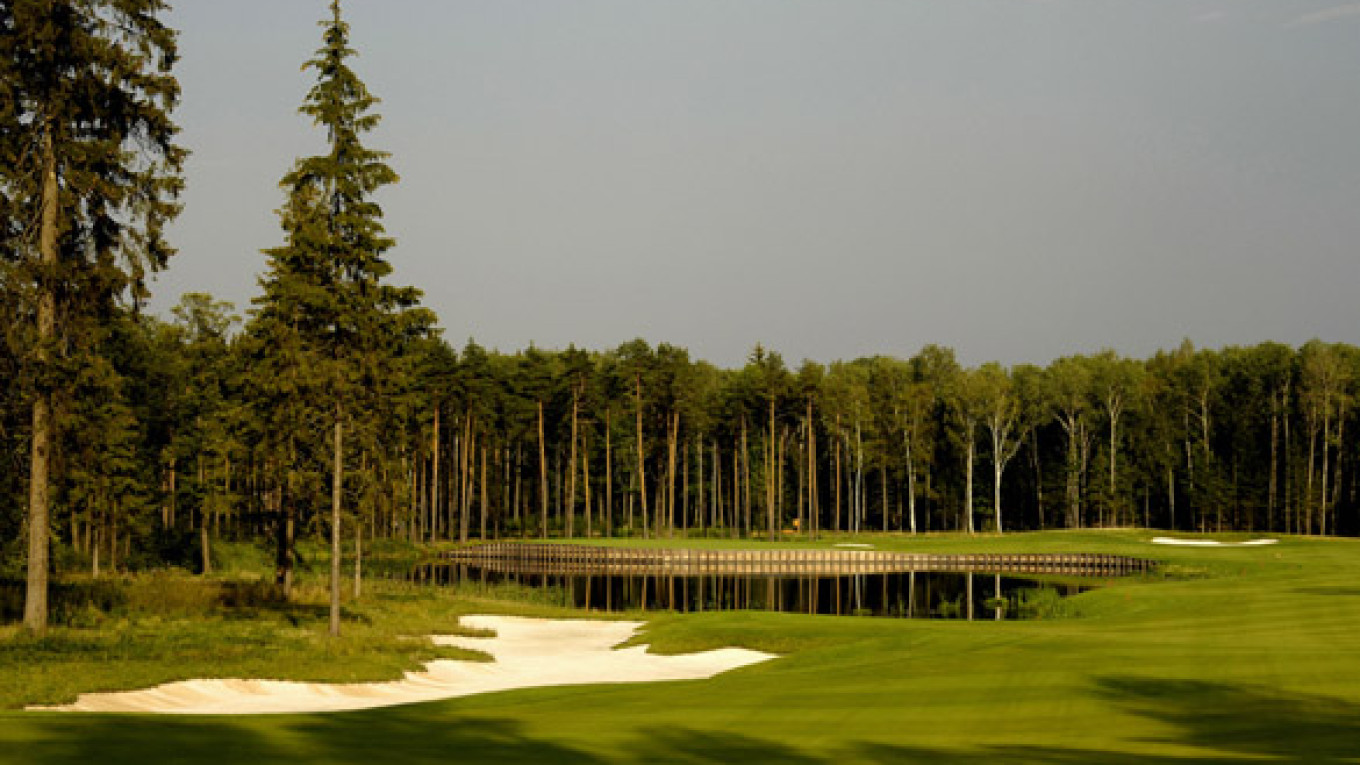
Oleg Deripaska isn’t letting $20 billion of debt handicap his golf game.
Like fellow billionaires Roman Abramovich and Vladimir Potanin, the 41-year-old golf enthusiast amassed and then lost billions of dollars on commodities. They now are turning to their hobbies as one way to help rebuild their fortunes.
Golf, snubbed by Communists as a sport for capitalists, wasn’t played in Russia until the twilight of the Soviet Union, and even now the country has just three 18-hole courses, one owned by Deripaska. At least 40 more are either being built or funded as investors pour $500 million into the sport this year alone, according to the Russian Golf Association.
“Russia is now one of the hottest spots for golf development,” said Andrea Sartori, the Budapest-based head of KPMG International’s Golf Advisory Practice for Europe, the Middle East and Africa. “Golf is still perceived as an elitist sport and current supply is mainly tailored to the wealthy Russian upper class.”
The golf association reckons the number of regular Russian golfers will swell to 100,000 by 2014 from 16,000 now and 500 in 2003 as more courses open and it gets cheaper to play.
In Scotland, where the sport was started in the Middle Ages, the national golf union covers 630 clubs and 260,000 players in a country with roughly half the population of Moscow.
Deripaska opened the Tseleyevo golf, ski and polo resort in December. The complex is 50 kilometers north of Moscow, and its centerpiece, an 18-hole course designed by six-time U.S. Masters winner Jack Nicklaus, cost $30 million. Membership fees are $300,000.
The billionaire completed the project after losing $25 billion of his wealth by Forbes magazine’s count, forcing him to cede stakes in Hochtief, Germany’s biggest construction company, and Canadian car-parts maker Magna International.
“We consider golf to be a promising industry in Russia,” said Vadim Prasov, manager of Deripaska’s golf business.
Tseleyevo is forecast to “pay off” in six to 10 years, he said.
That’s not to say the record 10.9 percent economic contraction in the second quarter hasn’t had an effect. The Moscow Open, the only Russian event on the PGA European Tour, was canceled in the summer after lead sponsor Inteco, the development company of Mayor Yury Luzhkov’s billionaire wife Yelena Baturina, backed out.
The country’s biggest golf investor may be Federation Council Senator Andrei Komarov, the main shareholder of pipe maker ChTPZ Group and one of 55 Russians on Forbes’s 2008 list of billionaires. He did not make the cut this year. The 42-year-old is plowing ahead with a $600 million project to build a chain of 18-hole courses in three regions. ChTPZ, by contrast, fired 25 percent of its workforce, or about 5,000 people, last year as demand for its products slumped.
“We haven’t cut planned expenditures because of the crisis,” though work has slowed at separate golf projects near St. Petersburg and Yekaterinburg, said Oleg Kustikov, chief executive officer at Protcion, Komarov’s development company.
An “ambitious” course in Russia costs at least $100 million, including real estate, Kustikov said in an interview in the ornate clubhouse at Pestovo, Protcion’s 18-hole complex 30 kilometers north of Moscow. Pestovo, which opened in 2007, cost $120 million and increased the value of surrounding property as much as 20-fold, Kustikov said.
Protcion bought the land around Pestovo for about $50,000 a hectare four years ago and expects to sell some of it for $1 million per hectare after the complex is built.
Potanin, who lost $20 billion according to Forbes, is building the PGA National course 100 kilometers northwest of Moscow, where the Russian national team will be based. PGA National is on schedule and will be completed in 2012, Potanin’s Open Investments said in an e-mailed statement.
Abramovich, who lost $16 billion on his investments, is building a golf complex 2 kilometers from Moscow’s outer ring road, making it the closest 18-hole course to the capital, according to John Mann, spokesman for Millhouse Capital, the Chelsea football club owner’s holding company.
While most golf projects in Russia start with the course and then add marketable properties, luxury-home builder Aras Agalarov, another businessman stricken from the Forbes billionaire list, is doing the opposite. Agalarov decided last year to build a course at his Agalarov Estates northwest of Moscow, where homes cost as much as $20 million.
How fast the golf industry develops in Russia may depend on whether the International Olympic Committee includes the sport in its quadrennial event starting in 2016, said Yevgeny Kafelnikov, the former top-ranked tennis player who is now one of Russia’s best golfers, with a handicap of two.
The government will have to fund the development of golf for it to become an Olympic event, said Kafelnikov, who’s a member of Deripaska’s Tseleyevo club. The IOC’s Executive Board has recommended that golf and rugby sevens be added to the games. A final decision will be made next month in Copenhagen.
“I am very excited,” Kafelnikov said by telephone from his Moscow home. “I can’t wait for the October decision.”
A Message from The Moscow Times:
Dear readers,
We are facing unprecedented challenges. Russia's Prosecutor General's Office has designated The Moscow Times as an "undesirable" organization, criminalizing our work and putting our staff at risk of prosecution. This follows our earlier unjust labeling as a "foreign agent."
These actions are direct attempts to silence independent journalism in Russia. The authorities claim our work "discredits the decisions of the Russian leadership." We see things differently: we strive to provide accurate, unbiased reporting on Russia.
We, the journalists of The Moscow Times, refuse to be silenced. But to continue our work, we need your help.
Your support, no matter how small, makes a world of difference. If you can, please support us monthly starting from just $2. It's quick to set up, and every contribution makes a significant impact.
By supporting The Moscow Times, you're defending open, independent journalism in the face of repression. Thank you for standing with us.

Remind me later.